Friday, April 23, 2010

Free & Easy Travel to Taipei, Taiwan from 17th to 21st March 2010

Photograph of a Giant Panda at Taipei Zoo.

Date of Travel: 17th to 21st March 2010
Via Air Asia X Flight No. D 72672 (9.50 AM to 14.50 PM) and Flight D 72605 (15.40PM to 20.50 PM).
No. of Travellers: 7 (Seven), i.e. Elder Sister, Wan Lai Meng, Younger Sister, Wan Lai Ling, Youngest Brother, Aaron Wan and Wife (Liza), My wife, Ting Sow Lan, my son, Wan Wai Yan and myself, Wan Heng Kei.
Return Fare: MYR 418/person (5 persons)
Accomodation: Lilai Hotel, No. 21, Sec 1, Zhonghua Road, Taipei City 100. The location of this hotel was superb as it was within walking distance to Ximen and Taipei Main Station Metro Stations. Due to our early booking, we had special rates at this hotel @ TWD 1180 (double occupancy + 2 breakfasts) per night with free wifi.

Free & Easy Travel to Taipei, Taiwan is very much easier now that Air Asia X has daily flights(from Kuala Lumpur LCCT) and also from Kota Kinabalu, Sabah. If you are going to Taipei, my recommendation is to travel on your own as Taipei has it vast network of communications such as Metro (few lines), 1st class roads & railways. My wife and myself have good memories of Taipei & Taiwan as the last time we were here was almost 29 years ago sometime in Sept 1981 as part of SA Mass Wedding & Honeymoon Tour of Manila, Taiwan (Taipei, Hualien, Kaohsiung, Tainan, Tai Chung, Sun Moon Lake and back to Taipei), Hong Kong and Macau. I vividly remember the first day when we arrived at Taipei, it was a public holiday being The Mid Autumn Festival or the 15th Day of 8th Month based on the Chinese Lunar Calender. Back then in 1981, Taipei City was jammed with vehicles (as there were no metro or first class railways) but now it is so easy to travel within this tourist-friendly city. Clean f.o.c. toilets are every where; free filtered drinking water & sometimes hot water can be found in public places (e.g. Danshui Metro) and Taipei Zoo. With the exception of National Palace Museum (it f.o.c. on Saturdays from 5pm to 8.30 pm), The Taipei Zoo and Yehliu Geopark, there are hardly any entrance fees (unlike China) and more so, the Taiwanese are one of the most tourist friendly people in the world.

About a week before our departure, the MATTA Travel fair was held at Putra World Trade Centre, KL and within walking distance from The Wan Family House in Tiong Nam Settlement. We managed to obtain some travel brochures & Taiwan Easy Card (pre-loaded with TWD 50) from The Taiwan Tourism Promotion Board. The Easy Card was given to all travellers who has travel bookings destined to Taiwan. The Easy Card can be conveniently used for most travels within Taiwan such as Metro, All Buses, Entrance to Taipei Zoo, etc., otherwise, you have to provide exact fares. So, if you are going to Taiwan, make sure you purchase the Easy Card on arrival there.

Wednesday: 17 Mar 2010 - Our Flight D 72672 arrived at Taipei International Airport approximately 20 minutes ahead of schedule. After immigration clearance, we proceeded to the Bus Transportation Center and at Freego Counter, we purchased return tickets directly to our hotel at TWD 260/person; child @ TWD 140. The journey took approx. 1 hour and upon arrival at Taipei, we have to change to another mini bus which took us to Ximenting (opposite Lilai Hotel) for check-in. A short rest and we are off to the nearby Ximenting; in the evening, we walked to Taipei Main Station; top-up our Easy Card and then took the Metro to Shihlin. From Shihlin, we walked southwards towards the night market for night shopping, dinner, etc. Finally towards Jiantan Metro for our trip back to our hotel at Ximen.

Thursday: 18 March 2010 - Early breakfast and then we took Taipei Metro from Ximen to Taipei Muzha Zoo (via Jhongxiao Fuxing Metro) from 9am until 12 Noon. Entrance fees @ reasonable TWD 60/person. The Taipei Zoo is one of the largest zoo in Asia. It displays animals from Taiwan, Africa, Australia, the Asian tropical rainforests, the desert and the temperate zone, an insectarium, amphibian and reptile house, penguin, koala and panda exhibition. In 2008, the Taipei Zoo received two Pandas from China named Tuan Tuan and Yuan Yuan (meaning REUNION) as a gesture of Unity. If you are in Taipei, you must visit the Taipei Zoo. it is one of the best zoos in the world.

After visiting the Zoo, we took the Metro to Taipei City Hall; from here we walk to the nearby TAIPEI 101 - presently the 2nd highest building in the world. There is a free bus service from Taipei City Hall to Taipei 101 but we opt to walk so that we could photographed 101 from the distance. We also visited the nearby Taipei 101 Mall, had our lunch there and then took the free bus shuttle to Taipei City Hall. On arrival, we took a 10 minutes walk to the nearby Sun Yat Sen Memorial Hall and spend an hour there; watch the changing of guards and in the late afternoon, returned to our hotel for a rest. In the evening, we took the metro from Ximen for 1 stop at Longshan Temple; visited the temple and thereafter visited the night market at Huasi Road, dinner and later back to Ximenting and our hotel for the night.


Photograph of myself, my son and wife taken at the entrance of Taipei Zoo


Another photograph of my wife, son and myself taken within Sun Yat Sen Memorial Park Outdoor Garden


Group Photograph my my elder sister, Lai Meng; my youngest sister-in-law, Liza, my youngest brother, Aaron, myself, HK Wan, my son, Wai Yan and my wife taken at Taipei 101 Mall


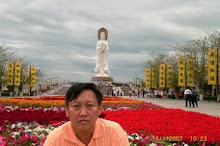
Group Photograph of myself, my youngest brother & wife, my son, my wife and elder sister taken at Chung Cheng Park, Keelung. The Statue of The Goddest of Mercy, Kwan Yin @ 22.5 Metres High is the largest within Taiwan.


Photograph of my wife & son taken at Yehliu Geopark


Another photograph of the Queen's head taken at Yehliu Geopark. In the photograph - my younger sister, Lai Ling, my wife, Sow Lan and myself, HK Wan

Friday: 19 March 2010 - Immediately after breakfast at Lilai Hotel, we walked to Taipei Main Railway Station and purchased 7 train tickets from Taipei to Keelung @ TWD 43/adult & TWD 22/child. The journey took 50 minutes. On arrival, we walked to the nearby bus terminal and took a bus to the nearby Keelung City Hall. From here, we walked our way up to Chung Cheng Park. It was a 30 minutes walk and rather tiring since we were walking uphill. However, I would recommend that you should take a taxi instead of walking (uphill). The Chung Cheng Park has 3 levels, the first level is a historical fort; the second level is a Buddhist Library and 2 temples, i.e. Chung Lieh Temple and Chu Pu Tan Temple. At the third and highest level, there is a statue of a smiling white Buddha and a 22.5 Metres white statue of The Goddest of Mercy, Guan Yin. This is one of the most popular landmark of Northern Taiwan. You can also climb the stairs inside the Guan Yin Statue for a splendid view of Keelung and the ocean. Due to rush to visit more places within Keelung, we spent about an hour or so at Chung Cheng Park. Thereafter, we walked all the way down from Chung Cheng Park to the nearest bus stop where we intend to take the stage bus from Keelung destined to either Jinshan or Danshui as we intend to go to Yehliu Geopark. Buses destined to Jinshan are more regular and the journey from this bus stop to Yehliu Geopark took about 1 hour. On arrival, we had our lunch at a nearby restaurant and then visited Yehliu Geopark. Entrance fees: TWD 50/adult. We spend approx. 2 hours at Yehliu Geopark. We then took a 20 minutes walk to the same bus stop and took another bus to Danshui. The journey slightly more than 1 hour and by the time we arrived at Danshui, it was almost 5.00 pm. Earlier, we have planned to go to the fisherman's wharf and the Red Fort but since it was already late, we opt to walk around Danshui Town, the night market, Danshui's promenade. It was quite an interesting place as you can watch public singers, performers, stalls of Taiwanese Food, etc.

At about 7.30 pm, we took the metro from Danshui to Longshan Temple (for dinner and Huasi Night Market) and finally back to our Hotel at Ximen.


Photograph of my wife, son and myself taken at the Sulphur Spring, Yangmingshan.


Another photograph of my son and wife taken at the Flower Clock, Yangmingshan Park.

Saturday: 20 March 2010: As our holidays coincide with early Spring, a visit to Yangmingshan is a must. We took the Metro from Taipei Main Station to Shihlin Metro and from here we boarded a mini Red Bus No. 5 to Yangmingshan. As it was a Saturday, the red bus was full and we were standing all the way for the 45 minutes ride to YMS Bus terminal. On arrival, we took the Bus 108 @ TWD 60/person for a 1-way circle route that serves all the attractions on Yangmingshan for a total of 13 stops. As we were in a rush, we only went for a few stops such as Xiaoyoukeng ( a sulphur pit on Mt. Qixing), Lengshuikeng ( Milk Lake due to the sulphur content of the water). As our visit to YMS coincides with the 2010 Yangmingshan Flower Festival (from 26 February 2010 until 28 March 2010) which was held within the vicinity of YMS's famous landmark, a large flower clock made of flowers with a diameter of 22 feet. Water runs around the flower clock and music is played every hour. It was blooming flowers every where and the park was exceptionally beautiful in spring with all kinds of flowers blooming such as cherry blossoms, Azaleas lily, camellia, peach blossoms, etc.

We left YMS at approx. 1.30pm and took Bus 260 back to Shihlin; had a late lunch and then proceed to Yuanshan Metro; from here we took Red Bus 21 to go to the Martyrs Shrine. On the way, the bus passed by
Taipei Grand Hotel which used to be one of Taipei's landmark. My wife and me visited this place way back in Sept' 1981. The Martyrs' Shrine was built in honour of 330,000 men who sacrified their lives fighting for the Republic of China (Taiwan). There were 2 military police officers guarding at the front gate and another 2 other officers guarding the main shrine. The guards are supposed to remained silent and still (like statues) during their shifts. You should not miss the changing-of-guards every hour as it was an elaborate process.

From Martyrs' Shrine, we took the same Red Bus 21 back to Yuanshan Metro and then to Jiantan Metro; from here, we took Red Bus 30 to Taipei's National Palace Museum. Our plans was to visit this place on Saturdays, after 5pm whereby it will be free of charge to all visitors (Normal fees: TWD 16,000). We arrived here at approx. 5.15pm. The National Palace Museum of Taiwan has permanent collections of ancient artifacts, artworks, porcelains, bronzes, paintings, jade, carvings, etc. of over 8000 years of Chinese History from neolitic age until the Ching Dynasty. A large number of the collections were obtained from China's ancient imperial families. It is also one of the largest and best museums in the world. If you are in Taipei, it is a must to visit The National Palace Museum. We left the museum at about 8.00 pm and proceed to Shihlin Night Market for our dinner and last minute shopping.


Photograph of my family, i.e. wife, son and myself taken at Sun Yat Seng Memorial Hall Garden


Another photograph of my family taken at Chiang Kai Shek Memorial Hall.

Sunday: 21 March 2010: This was our last day at Taipei as tomorrow being a Monday and my son, Wai Yan and my younger sister, Lai Ling (a teacher) would have to be back in school after the 1 week holiday break. As our flight was 3.40 PM in the afternoon, we do not want to waste any precious time. After breakfast at Lilai Hotel, we took the Metro from Ximen to Chiang Kai Shek Memorial Hall - 2 stops away and the next thing, we are already inside CKS Memorial Hall. It was a bit windy that morning and we had our coolest time in Taipei. CKS Memorial Hall was built in memorial of Chiang Kai-shek, former President of Taiwan. The monument was surrounded by a park as well as the National Theatre and National Concert Hall. The Presidential Building was also located nearby. A large bronze statue of a smiling and seated Chiang Kai-shek dominate the main hall. Military Police Officers guards the main hall during opening hours and the changing of guards take place every hour attracting visitors (similarly as at the Martyrs' Shrine and Sun Yat-sen Memorial Hall).

After visiting this place, we headed back to our hotel and made the necessary arrangement FreeGo Airport Bus to pick us up at 12.00 Noon. The waiting place was just 50 metres from the hotel and the airport bus arrived at approx. 12.30 pm bound to Taipei International Airport for our flight back to LCCT at 3.40 pm.

Although the 5 days4nights holidays at Taipei was rather short (during the March'2010 school holidays), we all really enjoyed our holidays at Taipei, Taiwan.


Posted by Wanhengkei on Sunday: 24 April 2010

Monday, September 7, 2009

Wildlife adventures at Naturelodge, Kg. Bilit, Kinabatangan & The Sandakan Trail

Photograph of myself, HK Wan, my niece, Wan Pik Ki, my elder sister, Lai Meng, my son, Wai Yan and my wife, Sow Lan taken Sandakan Harbour Square (facing Sandakan Bay)

Our Travel: 22nd to 26th August 2009 during the School Holidays

Our Group: HK Wan & Family (Wife: Sow Lan, Son: Wai Yan), my elder sister, Lai Meng, my younger sister, Lai Ling and my niece, Wan Pik Ki.

Our return fare: Special return fare of RM 60.00 per person via Air Asia. As flight was at 7.15am, we stayed the previous night at Tune Hotel, LCCT at a special rate of RM 16.18 per double occupancy. Also, it cost us RM 1/person for transportation to the LCCT.

Our Accomodation:
1) The Nature Lodge, Kampung Bilit, Kinabatangan
2) Sea Front Hotel, Sandakan Town @ RM 69/Room c/w 2 breakfasts & free Wifi

Photograph of my wife, my son & myself taken at Kun Yam Temple - one of the Sandakan Attractions within the famous Sandakan Walking Trail. It took us about 90 minutes to complete the entire Sandakan Trail including stopovers for taking photographs.

Photographs of the 2 (two) Orang Utans at the Sepilok Orang Utan Rehabitation Centre. As our visit coincide with the fruiting season, only 2 orang utans turned up at the Rehabitation Centre during mealtime at 10.00am. The primates prefer the seasonal jungle fruits rather than the usual diets provided at the Rehabitation Centre.

During one of our morning cruises, we managed to see 2 (two) orangutans in the wild. However, before I could video or photographed them, they disappeared in the thick secondary jungle.

Photograph taken at the Sepilok Orangutan Rehabitation Centre. It cost RM 4/adult for mini bus transportation from Sandakan Town to this centre. The admission fee was RM 30/foreigners and RM 5 for Malaysians & RM 2 for child. However, the camera or video's fee was RM 10 per unit.

Photograph showing a group of Proboscis Monkeys during our wildlife adventure. Proboscis primates are only found in Borneo (Sabah & Sarawak) and Kalimantan in Indonesia.

Photograph showing a herd of Pygmy Elephants in the wild. The pygmy elephants are only found in this part of the world. They are the smallest elephants in the world and their size are about that of a water buffalo.

Another photograph sh0wing a herd of pygmy elephants in the wild of Kinabatanagan. According to boatman, this was our lucky day to see such a large herd of pygmy elephants. Occasionally, due to their small stature, you can only partly see the elephants as they are blocked by the tall grass. At certain time of the year, the pygmy elephants may not appear at all for almost a month.

Our Lodge - The Nature Lodge, Kampung Bilit,Kinatatangan.
Our accomodation consist of a chalet with 2 (two) twin beds and built-in bathroom cum toilet. There is no TV, no internet, no access to mobile phones, no newspaper, really peaceful and keep us fully concentrated on the wildlife adventure, jungle trekking, etc. However, there was electricity supply throughout.

The cost of our accomodation was RM 315/person - a special rate for Malaysian only with a 20% discount for my 11 years old son. The foreigners pays much higher than us (due to a special discount). The cost include all meals, 2 wildlife cruises per day, jungle trekking and night walk (with jungle boots provided). Also, pick-up from Sandakan Town or Airport cost us an extra RM 15/adult (child: FOC)


Photograph of my wife, Sow Lan and son, Wai Yan cruising along the Kinabatangan River in the drizzling rain (in search of wildlife). Various wildlife were sighted during our cruises such as various primates like orang utans, proboscis, the long tailed macaques, the pig-tailed macaques, silver leaf monkeys, herons, king-fishers, various hornbills , eagles, etc. However, the most exciting adventure was sighting a large herd of pygmy elephants in the wild. A crocodile was also seen but moved away as soon as noticed.

Photograph of my wife, Sow Lan and son, Wai Yan resting within the locality of an ox-bow lake after a strenuous 90 minutes of jungle trekking. At this resting place, a blood-sucking leech managed to crawl to my son's navel but it was laughter all the way.

Another photograph of my wife and son cruising along the Kinabatangan River. My son was also enjoying his Sony's PSP Playstation during the cruise.

We left Sandakan on 26 August 2009 by a non air-con minibus and it cost us RM 1.50/person and the bus stopped right up to the departure hall of Sandakan Airport. In all our budget travels, this is our cheapest transportation to any airport.

It was a real wildlife experience for our 6 (six) members group as we were the only Malaysians amongst the caucasians during our stay at The Nature Lodge. Also, my 11 years old son enjoyed during this Wildlife Adventure at The Nature Lodge, Kampung Bilit, Kinabatangan.

Posted by HK Wan (Email: hengkei@gmail.com) on 7th September 2009


Free & Easy Travel to Yogyakarta from 5th to 8th June 2009


Buddha's statue in one of the opened Stupa within Borobudur Temple Complex.


Photograph of myself taken inside the Prambanan Temple Complex.


Myself, HK Wan, my elder brother, Heng Wah and my elder sister, Lai Meng taken at the Borobudur Temple Complex.

We planned our budgetted self-tour to Yogyakarta or Joyga about 9 months prior to our Air Asia Flight on 5 June 2009. Our return tickets cost us RM 220/person (excl. airport tax at Jogya) despite it was during the School Holidays so that my younger sister, Lai Ling - a teacher could accompany us.

There were 4 (four) of us, namely, my elder brother, Heng Wah, my elder sister, Lai Meng, my younger sister, Lai Ling and myself, HK Wan

On arrival at Adisucipto International Airport, we took the Prambanan Express Train to Tugu Railway Station at Joyya. It cost us Rupiah 7000/person. Our first ride on an Indonesian Train (although we travelled regularly by trains in other countries like Thailand, China, etc) . On arrival, we walked to our budget hotel, Mataram Hotel and stayed there for 3 (three) nights.

The next day, we booked a 7-seater MPV for our full day tour within Jogya, viz. The Buddhism Borobudur Temple Complex, The Hindu Prambanan Temple Complex, Merapi Volcano, etc. it cost us Rupiah 412,000/person including all entrance fees (excl. lunch). It was so easy as the tour operator was located right opposite our hotel.

The next day, we went on our walking tour within Jogya and visited various tourist attractions such as Jogya's famous Malioboro Street, Vredeburg Fort, Beriningharjo market, The Independence Monument, The Palace or Kraton, etc. We returned by horse-cart @ Rupiah 30,00 for the 4 (four) of us.


Photograph of my younger sister, Lai Ling taken at Tugu Railway Station, Yogya. This is the Prambanan Express Train from Jogya to Solo or Surakarta; a distance of approx. 60 Kilometres. The cost of the train ticket is fixed at Rupiah 7000, irrespective of the number of stops

My recommendation is that should you travel by air to either Yogya or Solo, you should not miss the cheap train transportation between the 2 cities @ Rupiah 7000/trip. The trains are regular scheduled and you should plan your holidays by visiting the best of both cities at budget prices.


Photograph of my younger sister, Lai Ling taken outside our budget hotel, Mataram Hotel. It cost us Rupiah 275,000 per night inclusive of a simple breakfast plus free WIFI.

This hotel is located just diagonally opposite the rear exit (for motor cycles parking). We were not aware of this exit. On our arrival, we just followed the crowd via the main entrance and ended up taking a 20 minutes walk to our hotel (instead of less than 1 minute) if we exited via the rear entrance.

Posted by HK Wan on 7 September 2009

Sunday, September 6, 2009

Free and Easy Holidays at Pattaya & Bangkok from 16th - 20th july 2009

My brother, Heng Wan, Sister-in-law, Rina, myself, HK Wan and my sister, Lai Meng cruising at Pattaya, Thailand on our way to Coral Island

Photograph of my brother’s family taken at The Grand Palace, Bangkok.

Left: My nephew, Wai Onn, Sister-in-law, Rina, Brother, Heng Wan and nephew, Wai Kit


Reasonable Western Breakfast at Pattaya @ Baht 60 per person. You can have various choices consisting of 2 pieces of toast with butter & jam, coffee or tea, plus bacon, ham, sausages and 2 eggs cooked in various styles.
The most reasonable and delicious Western breakfast at Pattaya at Baht 60/person. We can hardly find similar breakfast in Malaysia at similar prices.

We had a simple and economical 5 Days/4 Nights trip to Pattaya and Bangkok from 16th - 20th July 2009. Our group consisted by my younger brother & family, i.e. Heng Wan, Sister-in-law, Rina Chee and my 2 nephews, Wai Onn & Wai Kit plus my elder sister, Lai Meng and myself, Heng Kei.
We arrived at Bangkok Airport, cleared immigration and then took the airport shuttle bus to the transportation centre. From here, we boarded the Pattaya Bus @ Baht 106/each. On arrival, we took a Tut-tuk to our guesthouse - The Victoria Inn, Soi 6, Pattaya. It was a reasonable guesthouse with free wifi and cost us Baht 600/standard room. The next day, we had an economical tour to Coral Island, etc. plus lunch @ Baht 400 per person.

We left Pattaya on 18 July 2009 by Bus directly to Ekamai Eastern Bus station @ Baht 113/person. On arrival, took another bus to our guesthouse, The Riverview Guesthouse which was nearby Hualamphong Railway Station and Chinatown - which were our usual places of accomodation within Bangkok due to the reasonable food, shopping, easy transportation within Bangkok. The cost of our guesthouse was Baht 650/standard room. As usual, we had our usual Chao Phraya River Taxi ride to The Grand Palace and the nearby attractions.
We left Bangkok via our usual economical travel via train from Hualamphong to Hua Takhe @ Baht 7 person for almost an hour ride to this station. However, we were surprised that they have stopped the usual bus service from this station to Airport transportation centre (usual: Baht 15/person) but nevertheless, taxi services are available from here to the airport and it cost us a reasonable Baht 100/taxi right up to the airport.

Posted on 7 Sept 2009

Saturday, May 2, 2009

The Museum of the Former Residence of Dr. Sun Yat-Sen, Cuiheng Cun, Zhongshan, Guangdong


My elder sister, Lai Meng, my younger sister, Lai Ling & myself, HK Wan travelled from Jiangmen to Cuiheng Village. We took the bus from Jiangmen Station to Zhongshan @ RMB 16/person and from there. we boarded Bus No. 12 to The Museum of the Former Residence of Dr. Sun Yat-Sen, Cuiheng Cun. The journey took about 1 hour and the fare was RMB 5.50 per person. You can never miss this place as the Museum is on the main road and can be clearly seen from the bus stop.
On the day, 21/3/09, we were surprised that the entrance charges was free-of-charge, perhaps to commemorate Dr. Sun's death anniversary on 12 March 1925. The previous trip, I visited here was almost 4 years ago on 1st July 2005. I came with my octogenarian father and my elder brother and we were taking my father back to our Ancestral Hometown at Jiangmen, Guangdong. We came by mini bus from Gongbei @ RMB 10/person and the mini bus stopped right in front of The Museum of the former residence of Dr. Sun. At that time, the entrance fee was RMB 20 each for my elder brother & myself whereas my elderly father need not pay any entrance fee at all.

This museum is the most visited touristic site within Zhongsan Perfectural City. No trip to Zhongshan is complete without a visit here. Dr. Sun Yat-sen was born in Cuiheng village in 1866. He headed the Chinese Revolution that overthrew the Qing dynasty in 1911 and was sworn in as the Provisional President of The Government of The Republic of China on 1st January 1912. He also co-founded the Kuomintang (KMT) where he served as its first leader. He was also a uniting figure in post-Imperial China and well revered in both Mainland China, Taiwan and by overseas Chinese in Hong Kong, Macau, Singapore, Malaya, Thailand, Indonesia, America, etc.

The Museum of Dr. Sun Yat-sen, consisting of the Former Residence of Dr. Sun Yat-sen, Sun Yat-sen Memorial Hall, Cuiheng Folk House Exhibition and the Cuiheng Farming Exhibition, is a national protected cultural site to commemorate Dr. Sun Yat-sen.

The Former Residence of Dr. Sun Yat-sen
The Former Residence of Dr. Sun Yat-sen is a distinctive two-storey building. Dr. Sun lived here from 1892 to 1895, when he practiced medicine and engaged in revolutionary activities in the Pearl River Delta. There are many legacies about Dr. Sun’s childhood, his family, and his early education. The Former Residence is maintained exactly the same as the original look. In 1986, the Former Residence of Dr. Sun Yat-sen was ranked by the State Department “National Protected Cultural Site”.

Sun Yat-sen Memorial Hall
This Memorial Hall was built with the 40 million yuan raised by the municipal government and upon the approval of the State Administration of Cultural Relics. On exhibition here are the valuable historical photos and real objects reflecting the life of Sun Yat-sen. Equipped with advanced equipment, this is a modern multifunctional exhibition hall. The exhibition hall provides fascinating insights into the history of Chinese nationalism and an introduction to Dr. Sun Yat-sen’s life story, deeds, personality, thought and theory and revolutionary activities under his leadership. On the second floor is the exhibition of “Dr. Sun Yat-sen’s Relatives and Descendants”, reflecting their great support and contribution to the revolution and their sacrifice for the revolution led by Dr. Sun. The second floor also has rooms for temporary exhibitions.


Photographs of myself taken at Dr. Sun Yat-sen Memorial Hall


Photograph of China's most famous "Soong Sisters" taken at Dr Sun Yat-sen's Memorial Hall.

The 3 sisters, namely the eldest, Soong Ai-ling, the second sister, Soong Ching-ling and the youngest, Soong Mei-ling were the daughters of American educated Methodist Minister, Mr. Charlie Soong who made a fortune in banking and printing. Their mother was Ni Kwei-tseng.

In the 1930s, Soong Ai-ling and her sister, Mei-ling were the two richest women in China at that time. Both of them supported the Nationalists, while Soong Ching-ling later sided with the CPC. Eldest Sister, Ai-ling was the one who loves "money", she married the richest man and Finance Minister in China, H.H. Kung.

Ching-ling was the one who loves "China" was married to Dr. Sun on 25 October 1915. In the later years, she was a Vice Chairman of The Peoples Republic of China. She was the first non-royal woman to officially become head of state of China, acting as Co-chairman of the Republic from 1968 until 1972. She again became head of state in 1981, briefly before her death ( 29 May 1981), as President of China. Soong Ching-ling is sometimes regarded as Asia's first female head of state, although her title of Honorary President of the People's Republic of China was purely ceremonial.

Mei-ling was the one who loves "power". She was a prominent political leader in her own right, the wife and partner in power of the leader of the Kuomintang (KMT) , Generalissimo of the Chinese armies, and later President Chiang Kai-shek.

Posted by HK Wan, May 2009

Sunday, April 26, 2009

The Wan (Pinyin: Yin) Family Ancestral Home, Hehou Li, Jiangmen, Wuyi, Guangdong

Photograph of myself, Wan Heng Kei, my elder sister, Wan Lai Meng, my 85 years old father, Wan Kam Tai and my younger sister, Wan Lai Ling taken at the unoccupied Wan Family Ancestral Home, No. 57, Hehou Li, Jiangmen, Wuyi, Guangdong.


The Yin (尹) or Wan (Guangdong) surname
Yin (Chinese:) or Wan (Cantonese) ; pinyin: Yīn; was originally a pictogram of a royal headdress. It was first used in 2,597 BC by the son of Shao Hao (one of 5 kings in the "pre-China" Five Kings era), who took on the surname and became the Duke of Yin (a village in northeast China). In 1,783 BC, the Shang Dynasty created the Position of Yin (equivalent to First Minister, most-favored Minister, or Lord Protector). Lord Yi Chi of the Hua tribe helped orchestrate a near-bloodless coup bringing the Shang Dynasty to power, was rewarded with this title, and changed his name to Yi Yin (). In 800 BC, Bo Jifu, a renowned judge during the reign of Zhou Xuan Wang, also held this position, and changed his name to Yin Jifu. During the era of the Imperial Examination System, three other magistrates took on the surname Yin (尹) to denote their Imperial rank and royally-favored status. Yin settlements in China can be found south-west of Tonghui in Gansu Province, as well as in the Pearl River Delta.

The Yins are/were exempt from China's One-child Policy due to the rarity of their surname and reverence for their historical role.

Chinese : from the name of Yin City, in present-day Shanxi province, or from a status name of a government official. A grandson of the legendary emperor Huang Di (2697–2595 bc) was granted Yin City and in due course his descendants adopted the name of the city as their surname. Additionally, throughout the Shang (1766–1122 bc) and Zhou (1122–221 bc) dynasties, there existed a high government position called Yin. Many descendants of Yin officials adopted the status name Yin as their surname.


My Ancestors from The Wan Family originated from our Ancestral Home at No. 57, Hehou Li, Jiangmen City. This Ancestral Home was almost 200 years old. My siblings , my cousins and myself were the 23rd Generation whereas my father, Wan Kam Tai was the 22nd Generation. A copy of the Wan Family Ancestral Heirloom from 1st Generation until present is still available.

According to the Wan family heirloom, the 1st generation started during the Ming Dynasty. Although my father was born in Klang, Selangor, Malaysia; he returned to the Ancestral Home in 1930 together with my paternal grandfather, grandmother, my father elder sister, younger brother, younger sister and my father. Thereafter, my paternal grandfather returned to Malaya to work for my grand-uncle but passed away the following year of tuberculosis. My father and his sublings spent their childhood and education at Jiangmen until 1938 until the Japanese invaded Guangzhou. Due to the Japanese war attrocities against China, my father and his younger brother returned to the then Malaya to avoid the Japanese but not for long as by December 1941, the Japanese has begun their invasion of British Malaya.

According to my father, when he was staying and studying at Jiangmen in the 1930s, there were about 80 houses within Hehou Li and all these houses were exclusively owned the Wan or Yin Clans but some of the houses were rented out to others families. However, during our last visit in March 2009, there was only about 3 (Three) Wan Families left. Some of the houses were demolished into apartments, hotels. One of the still remaining Wan Family was the present neighbour at 56, Hehou Lane. The elderly Mr. Wan of House No. 56 was 2 years younger than my father and he was my father's school mate. He belongs to the same 23rd generation as myself or my siblings.
During the latter years of the 19th Century and until the 1950s, most of the Wans from Hehou Li have migrated to Malaya, Singapore, Hong Kong, Macau, Vietnam, America, etc. This include my paternal grandmother and my father younger sister (Auntie) who migrated to Malaya (via Hong Kong) in 1951 just after the Chinese Communists took over the country.


2) GONGKENG TEMPLE AND SPARROW FLOWERS


Photograph of my Jiangmen relative, Mrs. Mai Qiming, my younger sister, Lai Ling and elder sister, Lai Ling taken at the Bamboo Groove, Gongkeng Temple.


Photographs of Sparrow Flowers taken from Gongkeng Temple, Xiaopenglai Hill, Tangxia Town, Xinhui. Jiangmen,

The Sparrow Flowers is one of Jiangmen's precious plants. Every year around April, strings of blossoming Sparrow flowers hang all over the branches. Every blossom has a "head', 'tail'. 'mouth' and 'eyes'. When breezes sweep by, the 'wings' flap on and on just like millions of sparrows that are about to fly.
Gongkeng Temple which is situated at Peng Lai Mountain (Pinyin: Xiaopenglai Hill) of Tangxia Town, Xinhui - about 13 kms south of Jiangmen City is the best place to watch this beautiful sight. It is well covered by green woods with small stream runs through Gongkeng, making it a famous tourist site within Jiangmen.
On the hill of Gongkeng, there is an ancient temple, TIANCHENG TEMPLE (also named Gongkeng Temple) which was built during the last years of the Song Dynasty. On the left of the temple is the "Rock of Dragon Head". There is water running out from the rock all the year round. The water is cool and sweet, called "Dragon Fountain Water". Beside the rock is the three-storey Yiyun Tower. From here, you can get a full view of the scenic spot within Gongkeng Temple. There is a long winding path leading up the hill. The path is sheltered by big trees and sparrow flower vines. Along the path, you can see fantastic scenic spots, such as Guanyin Rock, Yading Rock, Tagong Pavilion, Wangjiang Pavilion, Immortal's footprint, etc.
Around Gongkeng Temple grows an extraordinary kind of creeping and climbing plant - the vine of Gongkeng Sparrow Flower. It is called the 'exotic flower of South China'. The wine stems, which twine around the big trees, hanging like swings and ribbons. The vine blossoms during the Qingming Festial for about a month.
The flowers looks like a sparrow, and almost the same size. Clusters of flowers hang on the vines like thousands of sparrows nestling in the tees. Each creamy colour flower has one receptacle and four petals. The receptacle is like the head of the sparrow, with two black spots like the eyes on two sides. The petal in the middle looks like the body of a sparrow, and the two petals on the sides look like two wings. The petal underneath stretches like the tail. The styles and stigmas inside are like the internal organs. If the flower is scratches, it will shed a small amount of red juice - just like the blood of the sparrow. One or two hours after the flowers are plucked down from the tree, the colour becomes brown, just like the colour of the feather of a real sparrow.

HK Wan (Email: hengkei@gmail.com)

April 2009

Saturday, January 31, 2009

The WAN Family of Tiong Nam Settlement, Kuala Lumpur, Malaysia - (Photograph taken on 31 January 2009 at The Royal Selangor Club, Kuala Lumpur)


Front Row: Marcus Wan, Wan Lai Meng, Aaron Wan with Baby, Keegan Koid, Wan Heng Wah, Wan Wai Yan, Wan Pi Ki & Rina Chee
Middle Row: Ivan Wan, Wan Heng Wan, Wan Mei Suet, Wan Lai Ling, Patriarch of the Wan Family, Wan Kam Tai, Doreen Ting & Wan Heng Kei
Back Row: Wan Wai Wen, Wan Wai Kit, Wan Wai Onn, Doreen Cheong, Wan Ee Lin & Husband, Koid Hsiang Lin
Not in the picture: Grand Daughter Wan Po Yee (Studying in Purdue, Indiana, USA) & Wan Heng Lim